Infectious human adenoviruses are shed in urine even after disappearance of urethral symptoms hanaoka2019infectious
Comparative study in Japan (urology STI clinic, June 2014–May 2016) of male patients with acute urethritis and asymptomatic male volunteers. First-void urine (FVU) samples were screened for urethritis-related pathogens including human adenovirus (HAdV). HAdV DNA was detected by real-time and nested PCR and quantified by real-time PCR as copies/mL urine; infectious virus was assessed by culture isolation in A549 cells with confirmation by cytopathic effect and PCR. This extraction captures individual longitudinal urine HAdV DNA measurements (copies/mL) from a CSV derived from figures/tables, timed by days from symptom onset.
Analytes
urine_adenovirus_viral_load
Quantification of human adenovirus (HAdV) DNA in first-void urine using real-time PCR (with HAdV detection also performed by real-time and nested PCR in the study). Values reported as copy number per mL urine (copies/mL). Virus isolation in A549 cells was also performed in the study but is not part of this numeric analyte.
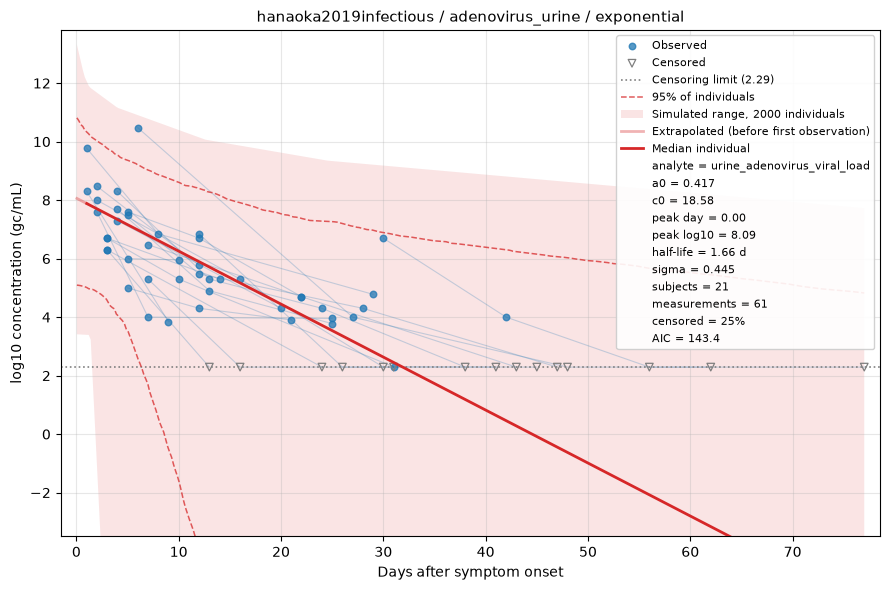
Fitted by censored maximum likelihood. The red line is the median individual; the shaded region is the full range of a simulated cohort drawn from the fitted population, so it shows what simulating from this dataset would produce rather than a confidence interval, with dashed lines at the central 95%. Open triangles are non-detects, drawn at the censoring limit and entering the fit as "below this value" rather than being dropped. See the modelling methods for what these estimates do and do not support.